
 Technology
Chapter 3
Technology Usage
How modern MSPs manage technology stacks, GRC, security, and AI adoption.
Overview
Accelerated AI Adoption Drives Performance — and Divides MSPs
As AI becomes table stakes for more MSPs, it comes with both productivity gains and (familiar) tech stack challenges around cost, complexity, and governance. While MSPs are split over its impact on staffing, top performers are using it to drive internal efficiency today — and scale client impact tomorrow.
Bigger Tech Stacks Boost Performance at a Cost
MSP tech stacks grew slightly this year, with more providers reporting 16+ apps compared to last year — likely driven by the rise of AI and increasing stack maturity. Having more tools is associated with better performance: top earners are more likely to have 11–20 apps, while average MSPs tend to use fewer than 10.
MSPs with the highest staff utilization (76–99%) tend to use 16-20+ apps, while those with lower utilization rely on fewer solutions, suggesting that more robust, mature tech stacks can boost productivity. However, since higher utilization was linked to higher client churn risk in Chapter 2, MSPs may need to strike a balance between having too many tools for staff to manage vs. investing in ones that drive efficiency and boost staff capacity.
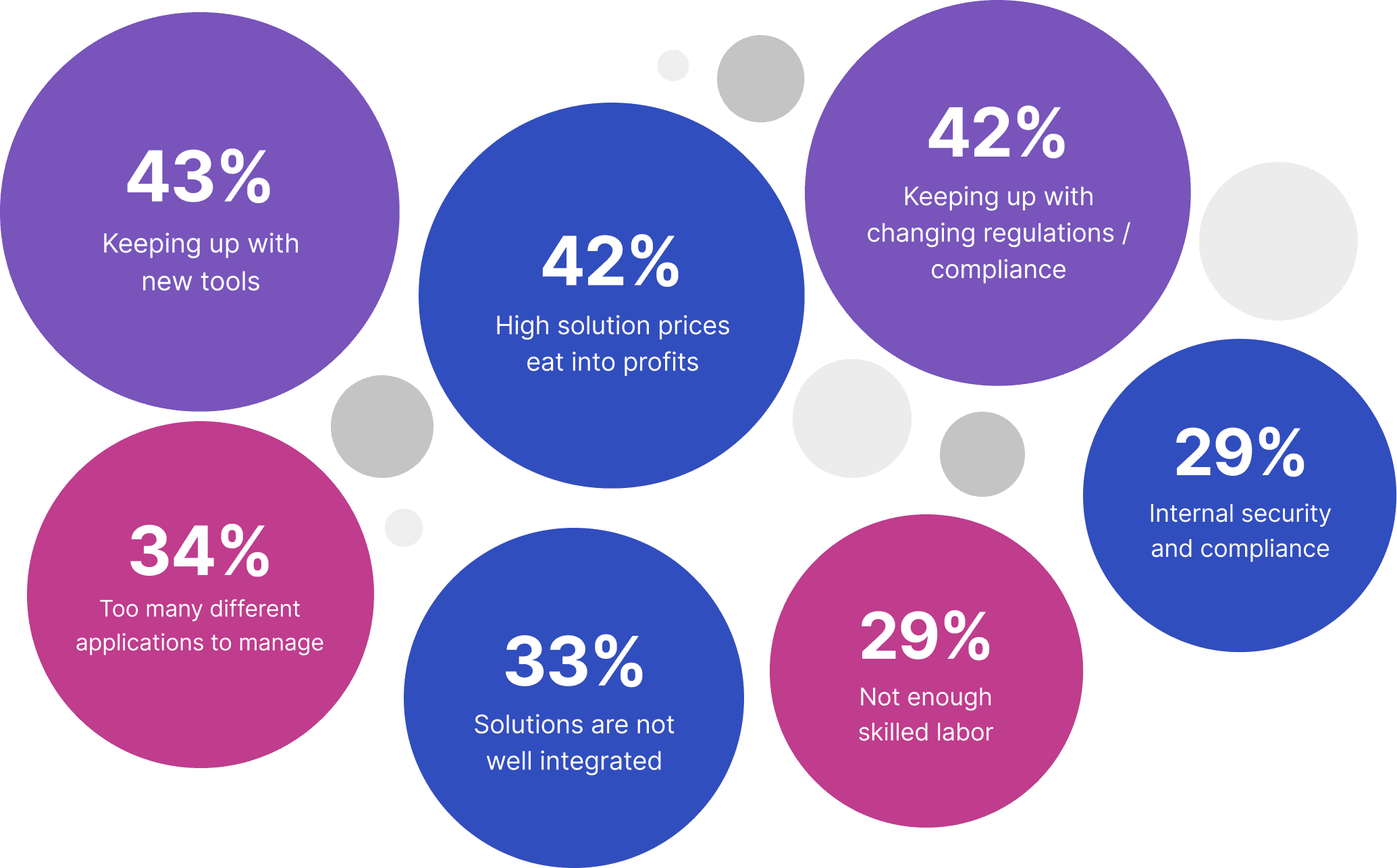
While larger tech stacks may improve performance, they come with challenges: keeping up with new apps, rising solution prices, and changing compliance/security concerns are making managing tech difficult for MSPs — especially as AI tools introduce new learning and training demands (which we’ll explore in this section).
Top Tech Stack Challenge
Most Popular MSP Tools
Curious what software your MSP peers have in their tech stack? These are the most commonly used tools across each category (in alphabetical order).
Professional Services Automation
- ConnectWise Manage
- Datto Autotask PSA
- Syncro
Quoting and Procurement
- ConnectWise Sell
- Kaseya Quote Manager
- PandaDoc
Backup Disaster and Recovery
- Arcserve
- Barracuda MSP
- Datto Backup - Kaseya
Endpoint Security
- CrowdStrike
- Microsoft Defender
- SentinelOne
Compliance and GRC
- ControlMap
- Drata
- Vanta
vCIO / QBR Prep
- CloudRadial CSA
- Lifecycle Manager
- MyITProcess
Documentation and Knowledge Management
- Confluence (Atlassian)
- Hudu
- IT Glue (Kaseya)
Remote Monitoring and Management
- ConnectWise Automate
- Datto RMM
- NinjaOne
AI Adoption Surges, With Top Use Cases in Data, Security, and Automation
The majority of MSPs now have a documented AI roadmap: 39% are executing their plans, while 36% have yet to do so. However, nearly half feel their adoption of AI has only been “Somewhat effective,” while almost a third feel they are “Very effective.” (Unsurprisingly, those with a documented strategy report more successful adoption).
MSPs who are executing on their AI roadmaps are more likely to report running “Very effective” QBRs and having greater confidence in showing business value to clients. Since reporting is one of the top AI use cases, this may indicate that smart automation makes collecting and sharing key client metrics simpler for MSPs. Other top uses focus on day-to-day MSP operations, especially security and monitoring, operational automation, and internal or client communications.
Custom vs. Vendor-Embedded AI
About a quarter of MSPs rely primarily on AI within existing vendor solutions. However, the most successful MSPs are likely customizing AI for more sophisticated use cases in their business:
MSPs with higher ARPU are more likely to use AI for data and automation than lower ARPU earners (who are more likely to say they rely on vendor-embedded AI).
MSPs focused on compliance use AI in more areas of their business — especially advanced automation and client engagement and support.
Those with high CSAT are more likely to leverage AI for internal and client communications, operations and workflow automation, and sales and marketing enablement.

Top AI Use Cases


Higher-performing MSPs are skeptical of AI hype because they’ve seen claims about technology disrupting the channel before. But skepticism isn’t fear. Since high-performers run lean, margin-driven operations, they’re used to testing and validating before adding new tools. They ask themselves practical questions, like ‘Do we have the infrastructure, credibility, and ability to sell this or add it to our stack?’
Kathryn Rose
Founder
channelwise
AI-Assisted Service Delivery Will Accelerate in the Next 2–3 Years
Today, 62% of MSPs say AI assists with 25% or less of client service delivery, with only a quarter of MSPs delivering 26–50% of services with the help of AI. However, over the next few years, most MSPs expect AI-supported service delivery to move beyond early adoption, with the largest share anticipating usage in the 25–75% range.
Top performers and executives are more likely to predict that 51–75% of services will be AI-assisted in the future, showing AI’s rising influence on operating models and business strategy.
AI service delivery seems to correlate with better overall customer engagement, as MSPs with more AI delivery support now — and higher projected usage in the future — tend to have:
Higher CSAT scores
Highly effective QBRs
High confidence in their ability to deliver value to clients
MSPs with higher staff utilization rates are more likely to report delivering 51–75% of their services with AI assistance.
They also tend to use it more for internal and client communications — suggesting AI may already be helping teams scale and maintain service levels.

AI Benefits Outweigh AI Worries — But Concerns Still Linger
Overall, MSPs are up for the challenge of figuring out how and where AI should be used. The majority (65%) see it as more of an opportunity than a risk. The top benefits MSPs report are around efficiency and time savings for staff, underscored by improved accuracy. When it comes to client-facing benefits, better reporting and faster response times top the list.
Despite the benefits of AI, MSPs are grappling with implementation challenges: cost and complexity are number one, followed by compliance and security concerns, and inaccuracies or hallucinations. Many MSPs already deal with high software costs, a lack of compliance and/or security expertise, and a need for accurate reporting — so integrating AI into systems already experiencing these issues may be tougher than expected.
MSPs Split on Impact of AI on Staffing
A little over half of MSPs expect AI to reshape — rather than eliminate — full-time roles. However, nearly one-fifth say AI has already replaced roles, and a quarter believe it will in the future — showing a clear divide between those who see AI automating work away vs. those who see it augmenting the work staff do.
AI strategy and hiring strategy seem increasingly intertwined. MSPs that report more effective AI adoption are likelier to say AI already has or will replace roles. Those freezing hiring are also more likely to report that AI has or will displace employees. However, MSPs planning to increase hiring in 2026 are also more likely to say AI has already reduced some full-time roles — suggesting that AI may not impact total headcount as much as it shifts the types of roles needed.
The AI divide doesn’t end there. MSPs with the highest utilization rates (76–99%) are more likely to either say that AI replacing employees is unlikely or that it already has — suggesting AI can be used to optimize workloads or reduce certain roles, depending on the MSP’s approach.
Belief AI Will Replace Full-Time Roles

If MSPs are already using AI internally, they should formalize it into a process and offer it to clients. This shouldn’t be given away for free — it’s expert-level assistance. MSPs that don’t yet offer AI readiness or AI integration services are missing a major opportunity. This space is growing fast, and if you’re not offering it, your competitors will.
Nett Lynch
CISO
Kraft & Kennedy Inc.
What Top Performers Do Differently
Bigger Tech Stacks, Targeted AI Use Cases
As noted earlier in this chapter, high performers tend to have more apps in their tech stack. Despite significant investment in their tech stacks, they aren’t necessarily bullish on adopting AI indiscriminately across their operations: they’re less likely to have formal AI roadmaps, less likely to believe AI will replace employees, and more likely to use AI for internal operations, like workflow automation or sales and marketing enablement.
Even with their measured approach to AI, they tend to see more positive results than average, from employee time savings to faster client response and resolution times. Overall, this suggests that successful MSPs embed AI into their tech stacks to boost internal productivity — and let humans stay focused on higher value tasks.