
 Financials
Chapter 1
Financial Performance
MSPs bank on expanded services and new headcount to drive revenue in 2026.

Financial Insights
High-Earning MSPs Have a Stickier Revenue Model
The highest earning MSPs have two things in common: higher ARPU and a higher percentage of recurring revenue — so offering clients more ongoing, monthly service packages outperforms more project-based models. MSPs also earn more when they serve highly regulated industries with more complex IT needs.
MSPs that offer more services and serve more clients also have higher revenue. However, small MSPs (1-10 employees) can also earn millions annually: nearly a quarter earn $1-3 million, and an elite 13% earn $3-5 million. But how do they scale service with so few resources? Operational excellence — which we explore in the next section — is likely the answer.

Most Profitable Industries

Financial services

Public sector

Healthcare
Total Annual Revenue
Average Revenue Per User (ARPU)
Where Talent Meets Technology, Revenue Grows
How do successful MSPs serve a high volume of clients? By balancing investments in people, processes, and technology to drive efficiency. For instance, MSPs with high staff utilization rates and “Very effective” AI usage are more likely to have higher revenue and ARPU.
Even with a well-utilized workforce and effective AI use, high-earning MSPs are more likely to be increasing hiring in 2026 — showing that operational strength creates the profitability needed to add headcount and scale.

High-earning MSPs are more likely to increase hiring in the year ahead.
Top Earners Excel at Customer Success — and Showing Their Impact
Client happiness is essential for growth and retention. So it’s no surprise that those with the highest revenue (and recurring revenue rates) have “Best-in-Class” customer satisfaction (CSAT) scores. High CSAT scores also correlate with higher projected revenue growth in the year ahead, while those with room for CSAT improvement project flat growth or losses in 2026.
One way top earners drive client success is their ability to show clients the impact of their work: MSPs who say their QBRs are “Very effective” and are “Very confident” in their ability to show clients measurable business value report higher revenue.



When you talk about renewals, clients are going to have outcomes or initiatives they need for their business over the next 1-3 years. When you go to renew, make sure you recap how you've supported those outcomes, and tie the renewal to the forward support of those initiatives with the upcoming goals for the program. That way, they’re not just signing a new scope of work — they’re signing their strategic plan for the next 1-3 years.
Jesse Miller
Founder & Creator of the PowerGRYD vCISO System
PowerPSA Consulting
Recurring Revenue Is a Priority — But Key Client Retention Metrics Aren’t
MSPs are focused on growing recurring revenue, with 78% reporting an increase this year. This explains why 58% of MSPs track MRR (the most popular financial metric). Interestingly, only a little over one-third of MSPs track client churn, even though losing contracts impacts MRR. Staying on top of churn could help MSPs better protect their revenue.
Small MSPs are less likely to have grown recurring revenue this past year. They’re also less likely to track metrics like customer churn rate, Customer Lifetime Value (CLTV) and Net Revenue Retention (NRR) compared to Medium (11-50 employees) and Large (51+ employees) MSPs. Tracking customer revenue-focused data points could help them perform better.
Recurring revenue movement
Percentage of Recurring Revenue
Top Financial Metrics Tracked
MSPs Balance Net-New Acquisition and Existing Client Expansion to Support Growth
Overall growth projections for 2026 are less aggressive than 2025: “Loss” and “Flat” projections are up a few percentage points, while growth rates over 26%+ dropped by 10% this year. However, the overwhelming majority are still forecasting growth, with over half expecting double-digit rates, signaling optimism amid potential economic uncertainty and market volatility.
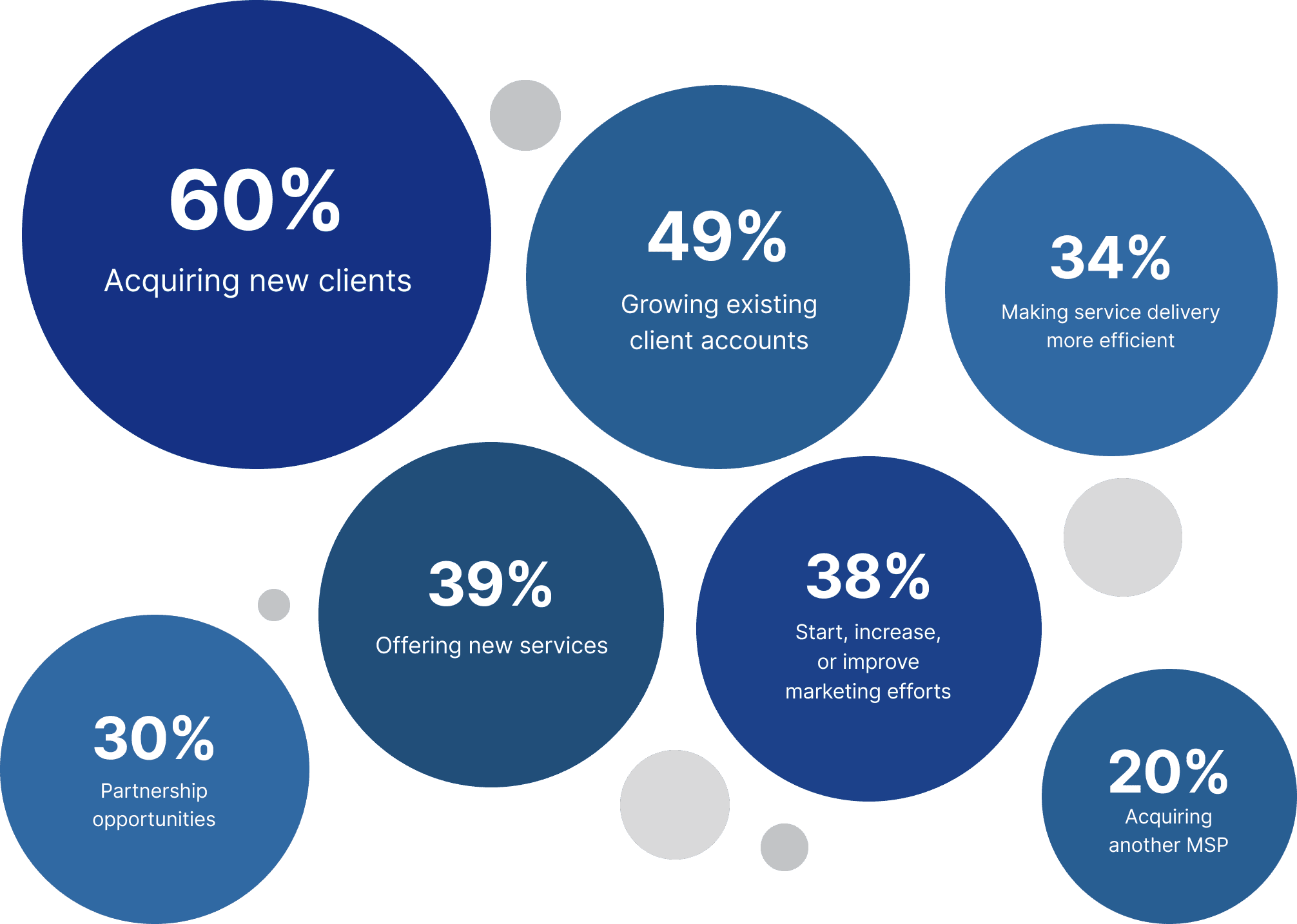
Those anticipating growth expect the top driver to be “Acquiring new clients” at 60% — a 13% increase from last year — indicating a more aggressive acquisition strategy. Interestingly, “Growing existing client accounts” jumped from the #4 spot last year to #2 this year (49% in 2026 vs. 35% 2025), suggesting MSPs realize the vital role customer expansion should play in their growth strategy (vs. net-new acquisition alone). Investments in sales and marketing remain stable, showing that MSPs aren’t dialling back discretionary spending that supports their growth.

Projected Growth Rate for 2026
Main Reason for Projected Growth
Early Compliance Adopters Earn More, Project Higher Growth
Compliance services make up a modest share of MSP revenue today, with nearly 70% saying compliance only drives 6-25% of revenue. Only 12% say it makes up over 25% of revenue.
However, MSPs that believe compliance will be “Extremely important” or “Somewhat important” in the next three years report higher revenue, ARPU, and recurring revenue than those who feel more neutral. Compliance-forward MSPs also expect more growth in 2026: those who consider compliance “Extremely important” are more likely to project growth rates over 50%+.
Clearly, those prioritizing compliance are poised to earn more — showing just how much potential revenue remains untapped in the market.
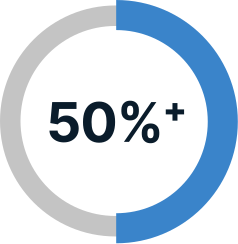
Projected growth rate of compliance-focused MSPs.
Percentage of Revenue Earned From Compliance Services

Vendors often position compliance as a magic revenue wand: add another product and everything gets better. But that only works if it’s something your clients actually want. Mature MSPs serving mid-market clients sell more compliance because their clients require it. When CMMC 2.0 rolled out, about half of my clients saw compliance take off, and the other half saw no motion at all. That isn’t random — it depends entirely on the market the MSP was already serving.
Megan Killion
Founder & Chief Consultant
Pisces Growth Consulting
Profile Of A Top Performer
What do the MSPs with the best overall performance do differently? We define a top performer (10% of those surveyed) as MSPs who have:
In each chapter, we’ll look at how they create their operational advantage and pull ahead of other MSPs.
What Top Performers Do Differently
Service Breadth and Data Depth Underpin Top-Line Growth
Top performers earn more by offering a wider range of services, spanning infrastructure, security, device management, backup and recovery, productivity tools, and strategic vCIO guidance. They also offer more types of compliance services.
They also track more financial data metrics. They’re more likely to track customer acquisition cost, churn rate, monthly recurring revenue, and overall profitability (EBITDA), which helps them monitor revenue closely and make more strategic decisions.

What Top Performers Struggle With

Tech (Dis)Integration
Top performers use more internal apps and tools, which is likely why they report having more integration challenges.

Project Management
They say this is an inefficient area in their business. But this worry might reflect their stronger awareness of it, not weaker performance.

Staffing Challenges
They worry about not having enough technical staff to serve clients and grow, so they may feel the talent crunch more than others.

Top performers are typically older MSPs — proving that strong revenue engines take time to build and refine.